
AI in an Accounting Office — Where to Start (and What Not to Buy)
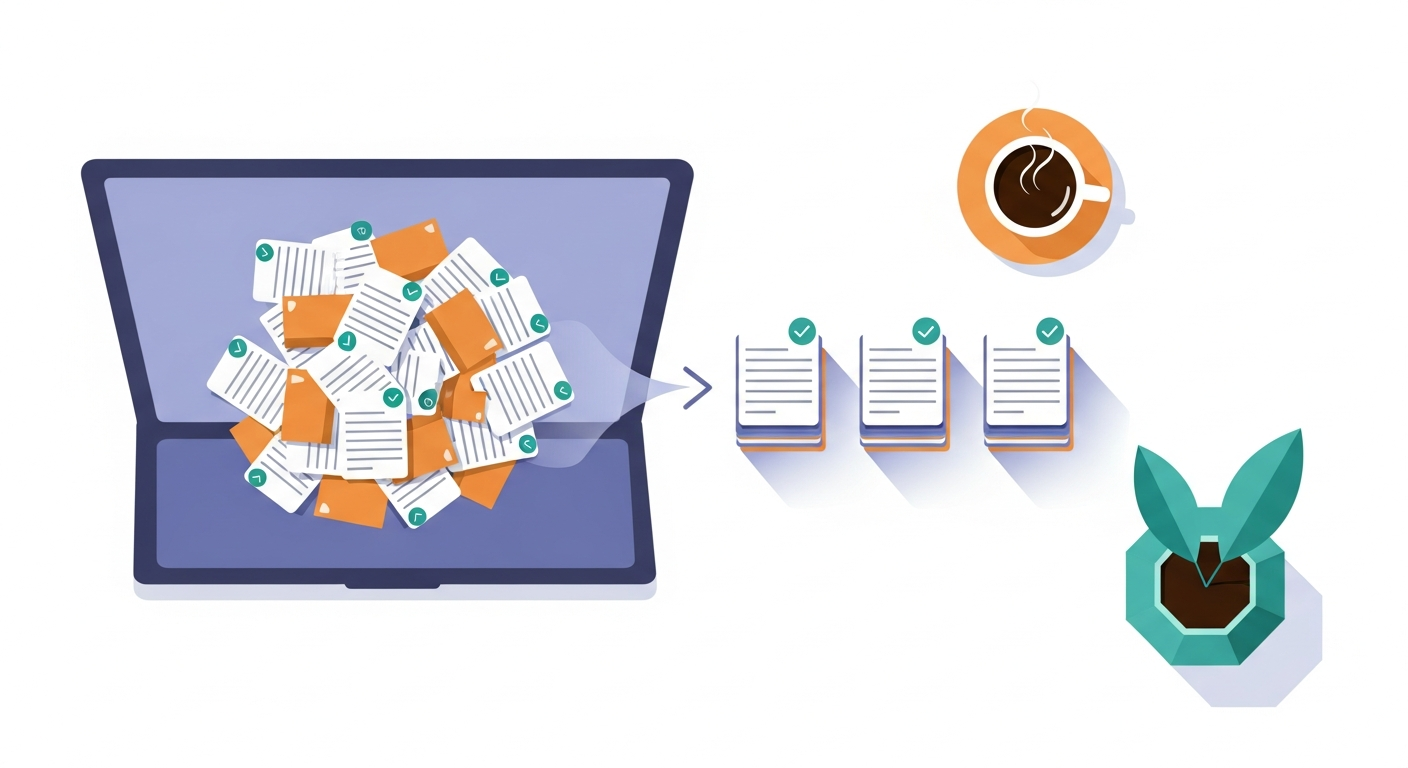
Every accounting office in Poland has now lived through the KSeF mandate. Intake went digital: purchase invoices arrive as structured data through one government API, issuing runs through the same pipe, and the shoebox of paper is — mostly — history. And yet the workload didn't drop the way the conference slides promised. The work moved. It didn't disappear.
That's the honest starting point for any conversation about AI in a biuro rachunkowe. The question isn't "should we use AI" — margin pressure already answered that. The question is where to start so that the first project pays for itself instead of becoming another subscription nobody remembers buying.
Start with an hour audit, not a tool
The first step costs nothing: figure out where your team's hours actually go. Not where it feels like they go — where they go. Take one week and have each accountant tag their time in rough buckets: entering documents, matching payments, chasing clients for missing papers, verifying contractors, answering "did my invoice get booked" emails, actual advisory work.
In every office I've looked at, the picture is the same shape. A mid-sized biuro with 40 clients averaging 150 documents each processes around 6,000 documents a month — and the majority of the time spent on them isn't reading. It's deciding: which account, which VAT treatment, which invoice does this transfer pay, is this contractor still on the VAT whitelist. Repetitive decisions on structured data. That is precisely the work AI agents do well — and precisely the work that OCR tools, chatbots and "AI features" in your current software don't touch.
The hour audit does one more thing: it gives you a baseline. When someone asks in three months whether the automation worked, you'll have a number to compare against instead of an impression.
What not to buy in 2026
Two purchases look like AI progress and mostly aren't — at least not for an accounting office after KSeF.
Another OCR tool. Recognition is a solved, commoditized problem — the established players do it well and cheaply, and I have no interest in competing with them on extraction accuracy. More importantly, the mandate changed the input: a purchase invoice pulled from KSeF is structured XML with every field already a field. Buying recognition software for born-digital data is paying to solve a problem you no longer have. Keep OCR for the shrinking stream of receipts and foreign paper; don't make it the centre of your AI strategy.
A chatbot as the first project. A website chatbot answers questions; it doesn't process a single document. Offices pick it because it's visible and cheap to try, and then conclude after three months that "AI didn't do much here." Of course it didn't — it was pointed at the 2% of the workload that was never the bottleneck.
The pattern behind both mistakes is the same: buying what's easy to demo instead of what maps to the hour audit.
The three processes where agents earn their keep
Document intake into draft bookings. Invoices arrive from KSeF, by email, occasionally as scans. An intake agent classifies each document, extracts or ingests the data, proposes the full booking — account assignment, VAT register, description — and posts it to the ERP as a draft. The accountant reviews a prepared entry instead of creating one. On a portfolio of standard trading and service companies, most documents are repetitions of decisions already made a hundred times; the agent learns exactly those repetitions.
Bank statement reconciliation. This is the strongest first candidate in most offices, and I've written up the mechanics in detail — MT940 in, matched drafts and an exception queue out. The short version: 80–90% of statement lines match automatically against open items, and the 10–20% that genuinely need judgment land in a queue instead of being buried in four hundred lines that don't. For a biuro this is the month-end sprint reduced to an exception review.
Recurring compliance checks. Contractor verification is the cleanest example: every new supplier and every payment above the threshold needs a check against the VAT whitelist, and doing it by hand means someone pastes NIPs into a government website all day. This is a small, well-bounded agent — and a good confidence-builder, because it's read-only: it verifies and reports, it never writes to the books at all.
Notice what's shared: each process has volume, a clear right answer for most cases, and a clean way to measure the automation rate. That's the profile of a good first agent. "Summarise this contract" is a nice party trick; it just isn't where 6,000 documents a month go.
The rules that keep the office safe
An accounting office signs its clients' books, so the liability question comes before the technology question. Three rules are non-negotiable in every implementation I do:
- Draft-only writes. The agent never posts a final entry. Everything lands as a proposal — in enova365, Optima, Symfonia or your SaaS invoicing tool — waiting for an accountant's approval. The saving is in reviewing instead of typing, not in removing the reviewer.
- A human approval loop with real information. An approval screen that just says "accept?" trains people to click yes. The agent has to show its reasoning: what it matched on, what alternatives it considered, why the confidence is what it is. Exceptions go to a queue, never into a silent guess.
- An audit trail and a DPA. Every proposal is logged with its inputs and its outcome, and the data processing agreement covers the client data flowing through the agent. When a client — or an auditor — asks how an entry came to be, there's an answer.
This framework is also the answer to the fear I hear most often from biuro owners: "what if it books something wrong?" It can't book anything. It can only propose, and proposals get reviewed by the same people who review junior accountants' work today — except the agent's drafts arrive complete, consistent, and at nine in the morning. If a vendor can't run in this mode, that's a red flag regardless of the demo.
Why a biuro sees the payoff faster than any single company
Here's the structural advantage an accounting office has over an in-house finance team: portfolio scale. A single company automates its own volume and stops there. A biuro runs the same intake and the same reconciliation ritual across dozens of clients — so a booking pattern learned on one client's portfolio transfers to the next, and the calibration work is paid for once and collected on every client added.
The arithmetic is straightforward. If a reconciliation agent saves six hours of matching per client per month, that's six hours for a company — and 240 hours for a biuro with 40 clients. Same agent, same integration, fortyfold difference in return. This is why I treat accounting offices as the primary buyer of these agents, not just another segment: the economics genuinely are better on your side of the table.
There's a second-order effect too. The offices that get through the review cycles faster don't just save cost — they change what they sell. The hours that stop going into matching transfers start going into the advisory work clients actually value, and that's the part of the fee schedule with margin left in it.
The first 30 days, concretely
Skip the strategy deck. This fits in a month:
- Week 1 — the hour audit and one choice. Measure where the time goes, then pick one process (intake or reconciliation) and one client portfolio — a cooperative client with decent volume and ordinary complexity. Not your messiest client; you're calibrating, not stress-testing.
- Weeks 2–3 — shadow mode. The agent proposes; your team books exactly as before. Nobody's work changes yet. At the end you compare: what share of documents or statement lines did the agent handle correctly without edits? That number — measured on your data, not a vendor's benchmark — is the basis for every next decision.
- Week 4 — drafts on, for that one portfolio. The team starts from the agent's drafts and the exception queue. Measure the same number again, plus the time spent. Widen client by client only when the drafts are boringly correct.
The failure mode to avoid is the big-bang rollout across all clients at once — reconciliation thresholds and booking patterns need calibration per portfolio, and shortcutting that period is how automation projects turn into cleanup projects.
I build these agents for Polish accounting offices — KSeF, email and bank feeds in; drafts, exception queues and an audit trail out; wired into enova365, Comarch Optima, Symfonia or your SaaS invoicing tool. If you want to know which of your processes would automate first and at what rate, get in touch — the scoping conversation is free and takes half an hour.
Let’s talk about your project
Free 30-minute consultation. We’ll figure out if and how I can help.